Death of a Salesman
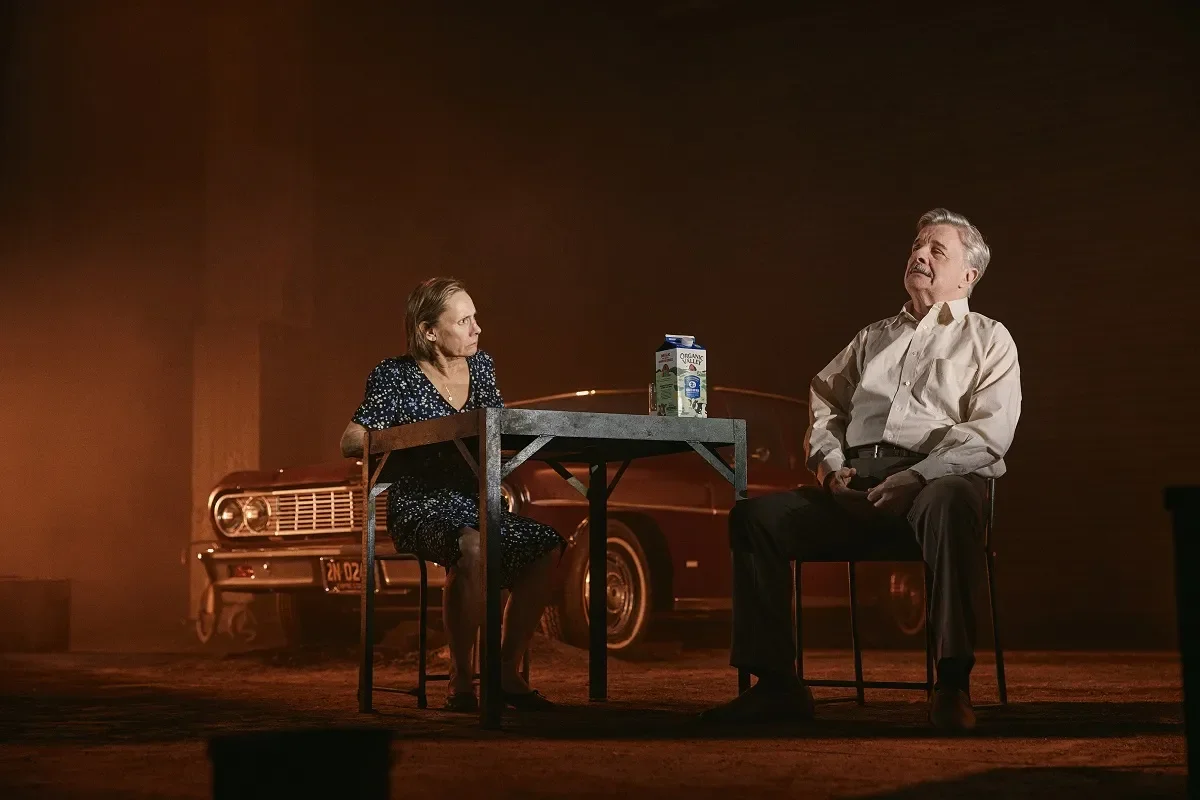
Laurie Metcalf, Nathan Lane (Photo: Emilio Madrid)
By Fern Siegel (posted 5/13/26)
Arthur Miller’s Death of a Salesman offers a gut punch to the American idea of success and the distance between illusion and reality. That chasm destroys Willie Loman and his family.
The current Broadway revival at the Winter Garden is seamlessly directed by Joe Mantello, with stellar performances by Nathan Lane as the defeated, blustering Willie, and Laurie Metcalf as Linda, his long-suffering wife.
Chloe Lamford’s spare set design, set in a garage, uses only a few props, which double as a kitchen, bedroom, club or office. It narrows the Lomans’ world, psychologically and economically, amid Willie’s angry bombast. The space is cavernous, better suited to a musical than an intimate family tragedy, but it works.
It opens with Willie driving a car onto the stage — and he exits, on his last, fateful journey, the same way.
Much as it did in 1949, Salesman offers a bleak commentary on those the American Dream leaves behind. Lane reaches down into the soul of suffering. No shtick, none of the exaggerated voice delivery he’s known for. His physical work is notable, a man suffering from his own myths. The performance is solid, real and like Metcalf’s, utterly believable. But it’s Metcalf who breathes life to a character who isn’t usually a star. She brings passion and grit to the role, a truth-teller in a family of self-deceivers. Her love for her 60-year-old worn-out husband is palpable — so is her disgust at her sons’ poor treatment of him.
Christopher Abbott plays Biff, the high-school football star whose future, Willie contends, is cut short by failing math. Summer school is the logical answer, but a random moment amputates all ambition. Similarly, Ben Ahlers as Happy, the older son, is aimless. A clerk who spends his time chasing women. Neither son has progressed to maturity. Like Willie, they drift on a sea of what-ifs. Both deliver solid turns. Their pathos and delusions are as mighty as their father’s.
And yet, we sympathize with Willie’s humiliation at the hands of a younger boss (John Drea), who casually discards his 35 years with the company. Even the dream-like memories of imperious brother Ben (Jonathan Cake) are larded with pomposity: “I walked into the jungle at 17 and walked out four years later as a rich man.” Willie keeps asking: “How did you do it?” Willie has dreams, but like his sons, his talents, such as they are, are limited.
The men who behave decently, neighbor Charley (K. Todd Freeman) and his grown son Bernard (Michael Benjamin Washington), project responsibility and hard work. Unlike Willie, who puts a premium on likability, they show up when needed.
The play offers younger versions of Biff (Joaquin Consueos), Happy (Jake Termine) and Bernard (Karl Green) in scenes shadowing their older counterparts. It adds to the cinematic nature of the production, as time travels back and forth. These snippets of memory outline the parameters of Willie’s narrow world.
“You can’t eat the orange, and throw the peel away—a man is not a piece of fruit.” The line is Willie’s anger at being discarded. And Linda’s famous “attention must be paid,” remains heartbreaking. Miller’s critique of the dark side of American prosperity, especially in the age of AI, resonates anew.