The Adding Machine
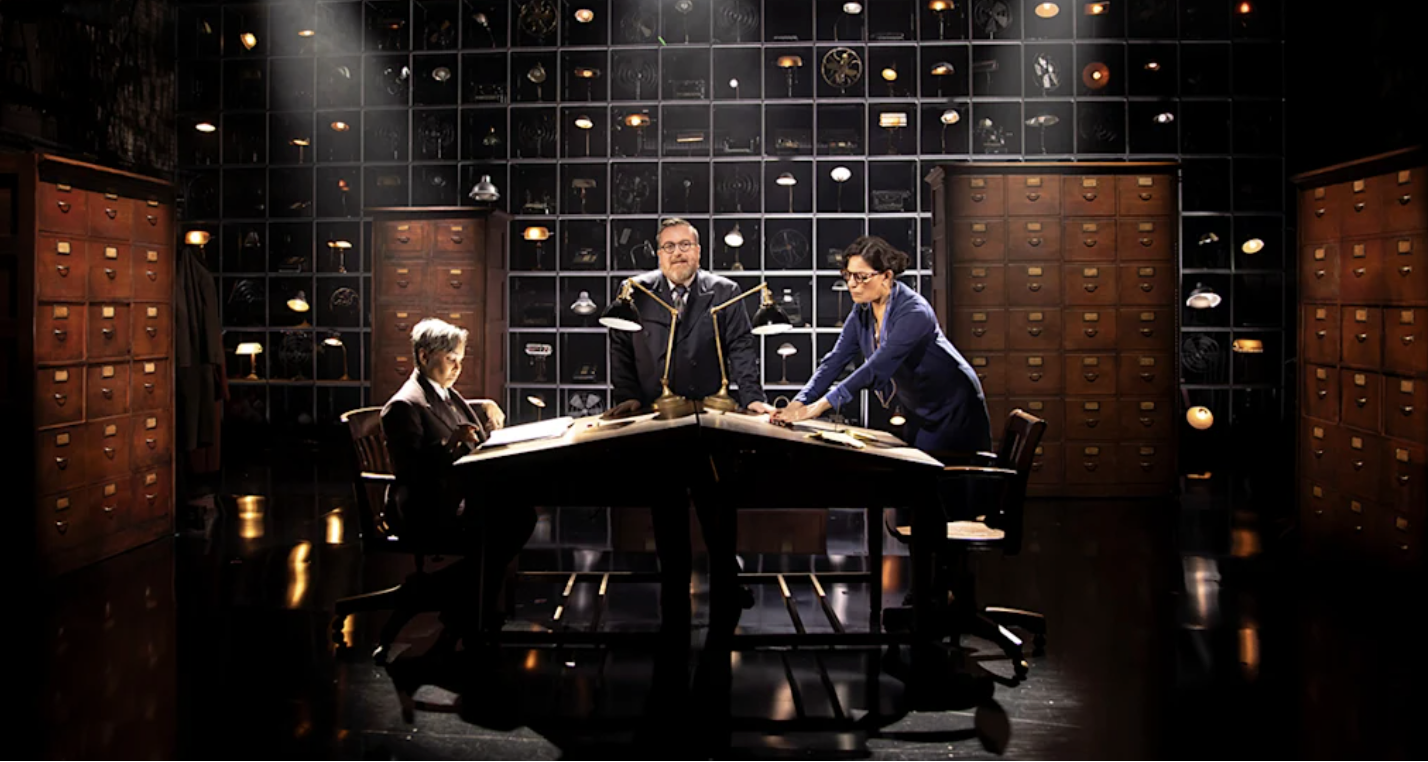
Daphne Rubin-Vega, Michael Cyril Creighton, Sarita Choudhury (Photo: Monique Carboni)
By Fern Siegel (Posted 5/10/26)
Elmer Rice wrote The Adding Machine in 1923, a play about the devastating effects of technology on employment. A bookkeeper with 25-years of dependable service is replaced by an adding machine touted as more efficient, without the need of skilled labor. Mr. Zero (Daphne Rubin-Vega), a cog in a corporate machine, will be replaced by a high schooler.
Zero’s shock and rage is palpable. The loyal drone who has never missed a day is dismissed with cool indifference. That triggers his one independent action: murdering his smug boss. In contemporary terms, he goes postal.
Now off-Broadway at the Theater at St. Clement’s, The Adding Machine is an expressionistic work. The language is stylized, often staccato. Rice isn’t writing a realistic play, though his themes remain relevant in the age of AI. He’s penned a social commentary on the chasm between workers and management, the value of labor and the impact of technology.
It’s also a look at Zero’s bored, complaining wife (Jennifer Tilly). The play opens in a Murphy bed detailing her disappointment. Her husband, lying beside her, is deaf to her travails. Tilly manages to elicit sympathy, even as she picks apart the remnants of a long marriage.
As directed by Scott Elliott, the cast, including Sarita Choudhury as Zero’s longtime co-worker, and Michael Cyril Creighton, playing various roles, explore Thoreau’s observation that “the mass of men lead lives of quiet desperation.”
Here, that wasteland is the endless repetition and emotional emptiness of drab existence, less lived than endured.
Thomas Bradshaw has revised Rice's script, though it’s unclear how. It’s refreshing that he’s kept the original text. While Zero’s economic woes unleash a barrage of nasty rhetoric aimed at Jews, blacks and immigrants, it’s not a surprise. The offensive language isn’t just true to the period, but tragically, our own. Censoring or whitewashing language denies tone. Let’s assume a discerning audience understands history and psychology. If they don’t, they aren’t ready for adult fare.
However, Rice’s target isn’t overly political. Zero doesn’t protest his innocence, only his anger at societal rejection. And despite the ultimate punishment, act two finds him in the Elysian Fields. What transpires effectively turns the concept of crime and punishment on its head.
Why object to death when life holds so little promise? What will bring release from urban toil and marital discontent? Rice, long concerned with issues of class and the humanity of workers, saw The Adding Machine as a modern morality tale.
David Cromer directed the musical version in 2008, memorable as much for its novel staging as its gut punch. Here, the setting is a confusing back wall of 1920s-period lamps and fans, and a few movable tables and chests. Spare set design can be hugely effective, but it must establish either mood or moment, which is semi-achieved in Derek McLane’s sets, aided by Jeff Croiter’s lighting and Catherine Zuber’s costume design. The plus to this iteration is the cast.
Rubin-Vega, in a gray wig and brown suit, perfectly captures Zero’s banality and desperation. He’s a man who feigns desire, but prefers denial or routine. Tilly and Choudhury are equally successful as the women in Zero’s life: The first as the embittered, disillusioned wife and the second, as the co-worker who hides her unrequited love beneath insults and asides. Both endure the grinding passage of time.
Given current economic worries, AI’s job eliminations and ongoing anti-Semitism and xenophobia, Rice’s Adding Machine feels hugely relevant and utterly modern. It’s a compelling play on many levels and important to revive.
But a big caveat: The music at intermission is loud, awful and distracting. So is the music played in the show. Why go to the trouble of period dress and props then inject contemporary music? One doesn’t have to improve or alter Rice. The Pulitzer Prize winner was a critical figure in pre-war theater. And 103 years later, his message still resonates.