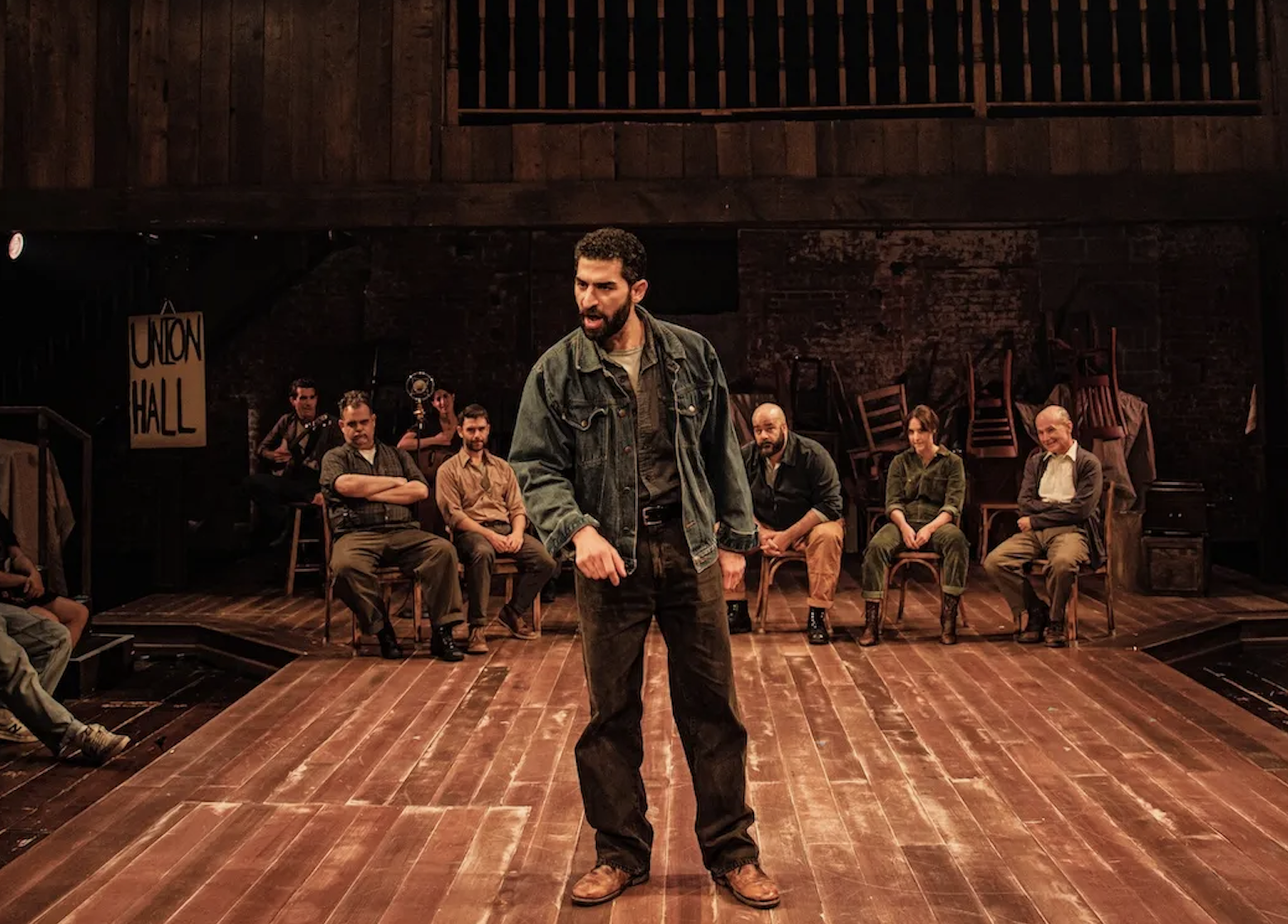
Raffi Barsoumian and cast. (Photo: Marc J. Franklin)
By Fern Siegel (posted 11-7-26)
Waiting For Lefty, Clifford Odets’ 1935 agitprop play about a potential taxi strike, put the playwright on the map. A powerful one-act, it’s set in a union hall in one of the worst years of the Great Depression.
And tensions are high as members wait for chairman Lefty Costello to arrive. Union boss Harry Fatt (Greg Hildreth) argues against the strike, accusing anyone demanding a living wage of being a “red.” Not “red,” shoots back a driver. “We’re the black-and-blue boys” who spend 10 hours a day in a cab.
Odet’s play, first produced by the Group Theatre and directed by Harold Clurman, was a rallying cry, a visceral series of scenes that illustrated lives in peril.
Joe (Raffi Barousmian) comes home to a wife (a hyper-articulate Tala Ashe) who insists he take action or she’ll leave. Their children are sent to bed without food and there isn’t enough money for rent. She’s even willing to proposition an old boyfriend to secure her family’s survival.
In another, longtime fiancés Florrie and Sid (Sahar Milani and Cameron Scoggins) can’t marry, due to their precarious economic state, while a gifted Jewish doctor (Adam Kantor) is fired due to antisemitism, and his charity ward shuttered. The hospital, deciding it isn’t profitable, replaces him with a incompetent son of a U.S. senator. “The men who know their jobs don’t run anything here,” his supervisor (Henry Stram) explains. “The Constitution’s for rich men then and now.”
Sound familiar?
Now off-Broadway at the CSC, Waiting for Lefty, a stark contrast between the haves and have-nots, still resonates, making the rarely-done revival timely. (Discussions of socialism vs. capitalism, the wide chasm between rich and working-class, comprised some midterm rhetoric. An audience handout notes the average American worker’s salary is $58,260 and we have the planet’s first trillionaire, Elon Musk, who has wreaked havoc on the U.S.)
It’s also actor Steven Pasquale’s directorial debut. Originally a 40-minute show, his Lefty mixes emotive slo-mo choreography by Susan Misner with original music and arrangements by Yeller Tooth. Two classic protest songs, “Bread and Roses” and “Brother, Can You Spare a Dime,” performed by the 10-person ensemble, are especially well delivered. While the added elements are artistically rendered, elongating the production to 70 minutes, they mute, to some degree, the build-up of righteous anger Odets wanted the audience to experience.
Yet the ensemble performances are uniformly excellent and the mood lighting by Mextly Couzin gives the sepia-toned production a perfect period feel. The issues are forever relevant and the scenarios moving. To his credit, Pasquale chose a rarely done Odets, the writer’s first produced play and an overnight success.
In fact, Odets is having a banner year. His two masterpieces: “Golden Boy” just closed in London and “Awake and Sing” arrives on Broadway mid-December starring Danny Burstein and Jessica Hecht.
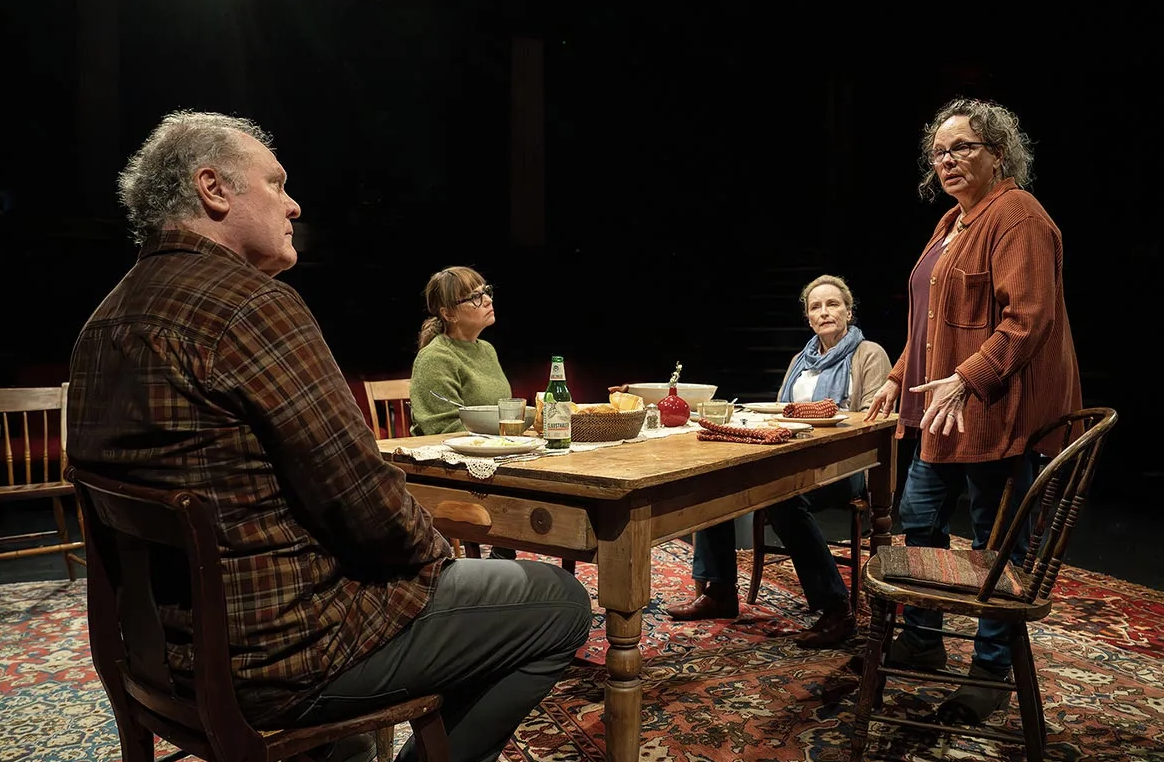
Jay O. Saunders, Sally Murphy, Laila Robins, Maryann Plunkett (Photo: Joan Marcus)
Politics is also the subject of We’ll See, now off-Broadway at the Public Theater. It’s Richard Nelson’s latest iteration of the Apple family of Rhinebeck, New York.
Each play happens in real time on a particular day and addresses political events. Here, it’s the eve of the midterms — and the family and country await to see if Trump’s mandates will be thwarted. Not that his name is ever mentioned, but the message is clear.
Nelson is preaching to the converted, which means Apple regulars Maryann Plunkett (Barbara), Jay O. Sanders (Richard), Laila Robins (Marian), Sally Murphy (Jane) and now Yvonne, Richard’s partner (Yvonne Woods), sit at a dining-room table and kvetch.
Even if you agree, We’ll See is devoid of any drama, tension or story arc. This is a rumination, not insightful theatrical fare. And because it’s theater in the round, audiences spend half the time watching an actor’s back, which can make catching dialogue challenging, as the women are soft-spoken. Due to playwright Nelson’s directorial challenge, the actors keep changing seats.
Commentary on current events is important, but there has to be something at stake for the characters. As is, Jane doesn’t bother to vote, making her comments irritating at best. A few blocks away, Waiting For Lefty lays bare the stakes in dire times. Odets’ pathos is palpable. For the suburban Apples, one realize they will be fine — no matter what.