Tartuffe
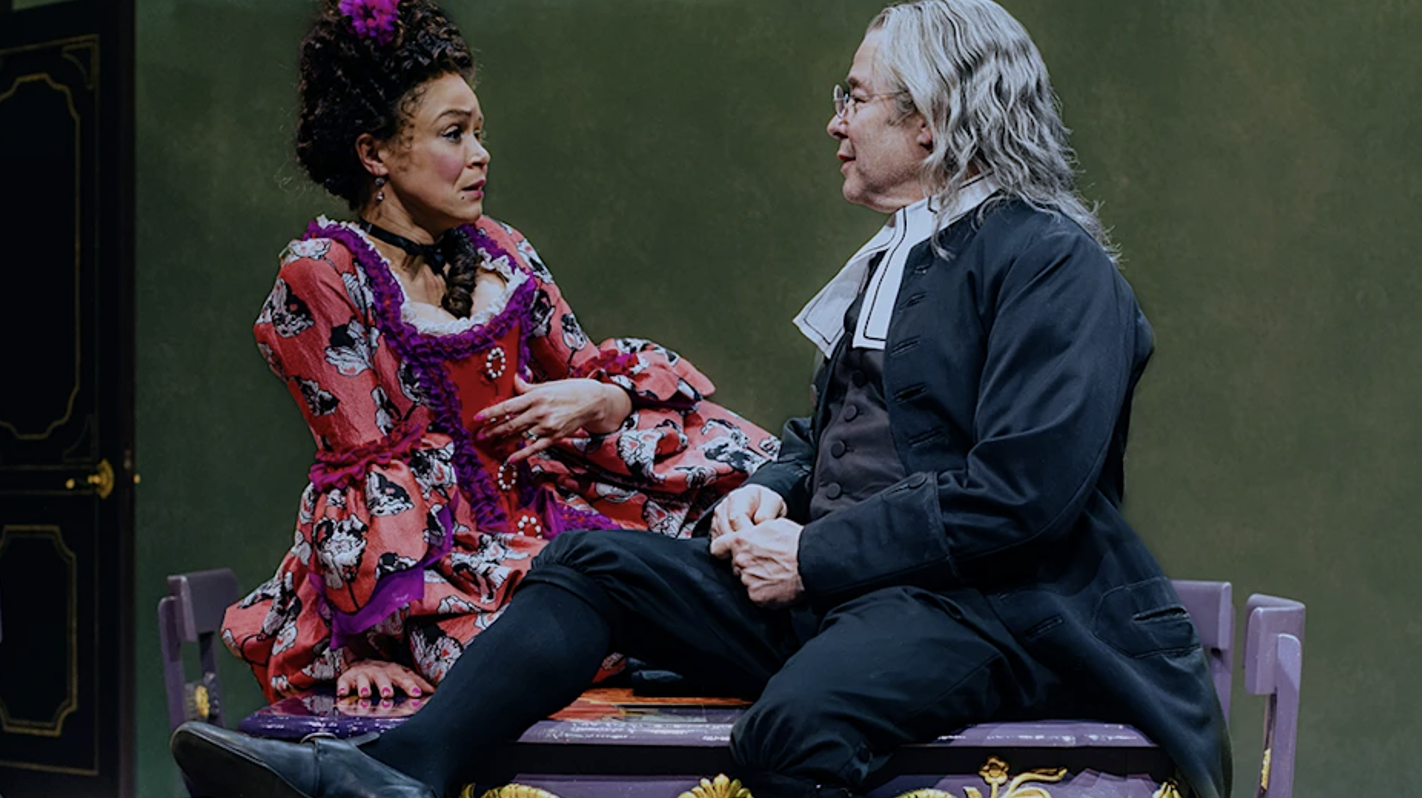
Amber Gray, Matthew Broderick (Photo: Marc J. Franklin)
By Fern Siegel (Posted 12/26/25)
Tartuffe, Moliere’s 17th-century farce about wealthy French people easily deluded by a religious hypocrite and moral reprobate, speaks to every age. Lucas Hnath’s new adaptation, now off-Broadway at New York Theater Workshop, utilizes more modern language, but the message remains: It’s easy to swindle those blind to reality, even in the face of overwhelming proof.
Clearly, it’s a play tailor-made for our time.
Written in rhyming couplets, the humorous lines land — “open mind or a lack of spine” — thanks to a strong ensemble cast: Amber Gray as Elmire, Orgon’s long-suffering wife, Francis Jue his brother-in-law, Bianca Del Rio, the haughty mother, Lisa Kron as maid, Emily Davis as the daughter, Ryan J. Haddad as the ignored son and Ikechukwu Ufomadu as Valère, who hopes to marry the daughter of the house.
They each embody their respective roles with speed and agility. And though she only has two scenes, Rio is especially fun to watch, as is Kron. Ufomadu nearly steals the show playing an assortment of quick-change figures.
The caveat — and it’s a big one — is that the ostensible leads, David Cross as Oregon and Matthew Broderick as the titular character, are remarkably weak. Both deliver their lines at a slow pace, versus the rest of the cast. Cross doesn’t have stage presence. He replays Tobias from “Arrested Development,” with an unfortunate habit of speaking too soon, thereby stepping on other actors’ lines.
Worse, Broderick reprises his whiny, nasal monotone and delivers a one-note performance. His Tartuffe lacks the charisma and malice necessary to command such slavish devotion. Instead, we keep looking for the old vaudeville hook to drag him offstage and save the production.
That’s a shame, because Moliere’s over-the-top satire, when done right, is a delight. It underscores how the gullible operate — to the consternation of everyone else — and the punishing aspects of those who reject common sense. Orgon wants his daughter to marry Tartuffe, despite her objections. Similarly, he’s blind to Tartuffe’s lasciviousness toward his wife, even in a comic scene where he listens to a feigned assignation under a table.
Such willful stupidity and indifference are highlighted in the exasperation of Gray, Haddad and Jue’s characters, who try, in vain, to expose truth in a sea of lies.
On the plus side, Enver Chakartash’s costumes set the right tone, but why Kron’s maid is wearing tennis shoes is a mystery. Some of Sarah Benson’s directorial choices are equally baffling: Why do two characters suddenly pretend to play tennis? Why does the cast burst into song at the play’s end, reassuring themselves they are still “good” people?
The minimal but sufficient scenic design is by dots, with lighting by Stacey Derosier, sound by Peter Mills Weiss, choreography by Raja Feather Kelly and inexplicable original music by Heather Christian.
Tartuffe should leave the audience with a clear sense of chicanery and the hope that wrongs will be righted by the comedy’s end. The send-up of power-hungry fiends and deluded fools isn’t new — but deflating the corrupt and hypocritical is always a joy to watch. Just not this iteration.