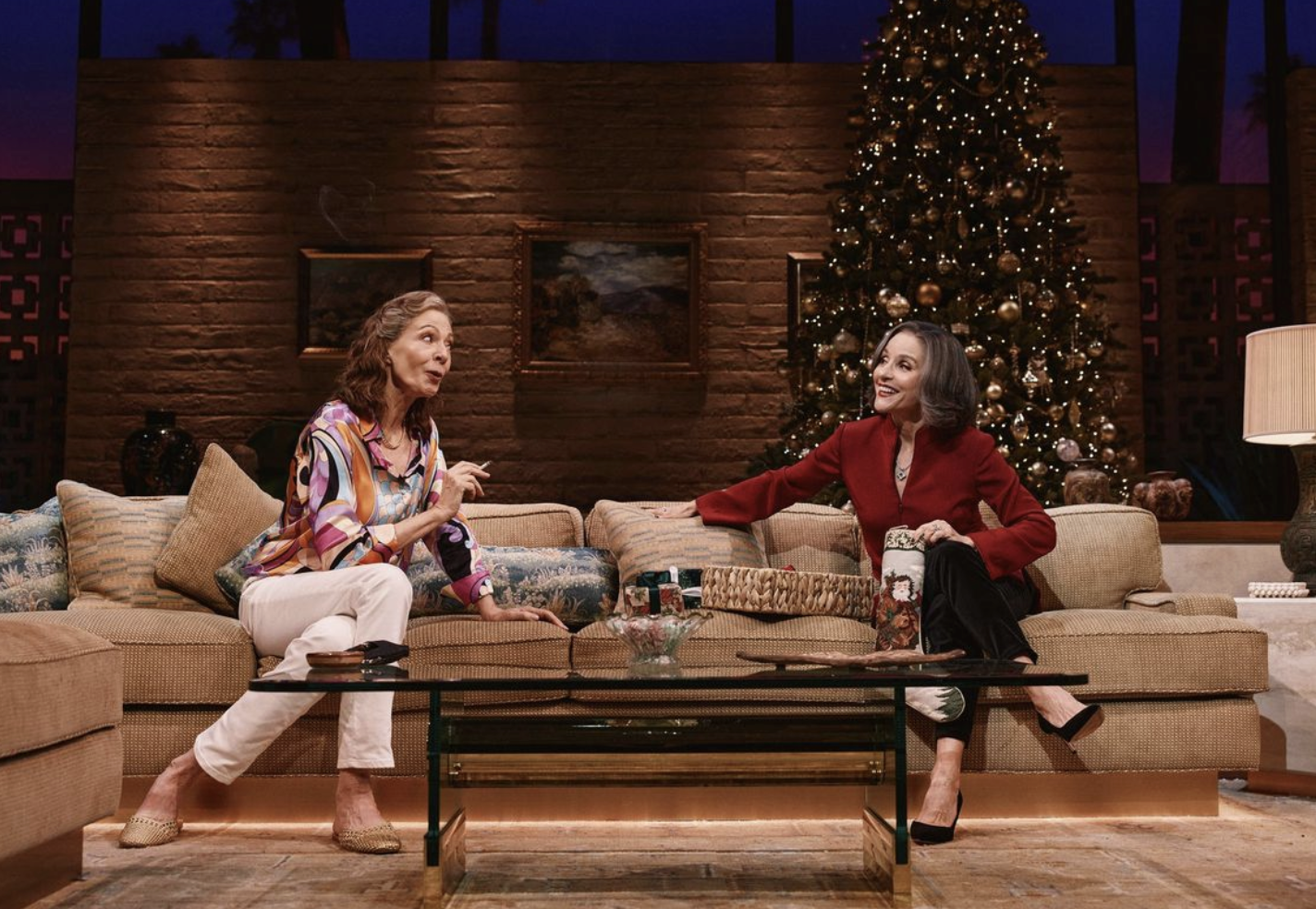
(L-R) Allison Janney, Julia Louis-Dreyfus (Photo: Emilio Madrid)
By Fern Siegel (posted 10/25/26)
Other Desert Cities is a triple threat: a stylish family drama, a top-notch ensemble cast and Julia Louis-Dreyfus’ Broadway debut.
Set in 2004 in Palm Springs, in the home of well-to-do Polly (Dreyfus) and Lyman (Ed Harris), it pits two Republicans against Brooke, their mentally unstable daughter (Lily Rabe.) She’s visiting for the first time in six years and comes bearing an unwanted Christmas surprise: a tell-all memoir.
As expected, her parents are less than thrilled by her accusatory tone. “Sarcasm is the purview of teenagers and homosexuals,” her steely mother announces. But the book isn’t just an indictment leveled by a daughter angered by the suicide of a beloved older brother. As we learn about the drug-addled, 1970s political radical that was Henry, and the family’s long-buried resentments, audiences get something more.
Now at the Hudson Theatre, Jon Robin Baitz’s compelling play, first presented in 2011, is a remarkable meditation on the state of left-right polemics. It also examines how people can stretch love, entitlement and secrets to the breaking point. “Families get terrorized by their weakest member,” Polly warns her son Trip (Joe Keery).
That’s true for parents confronting children or Polly’s acid-tongued liberal sister Silda (Alison Janney), her former writing partner, now living with the family after countless stints in rehab. “The woman’s liver needs a liver,” Polly sighs. Whichever pairing, the play crackles with a point-counterpoint dynamic — as funny as it is lacerating.
And it raises serious questions about what we owe each other. Money can create entitled children who think only of themselves, while indicting their elders. Conversely, it asks those eager to be socially accepted, what values they will forsake.
As such, the show, perfectly directed by John Benjamin Hickey, is witty, twisted and provocative. The pacing is brisk, but neatly calibrates the emotional spaces between confrontation and demarcation. That’s thanks to insightful dialogue; it blurs the knee-jerk reactions our current politics and cultural sensibilities demand. Other Desert Cities is that rare thing: a play that refuses to cater to social expectations.
It also explores, in often painful detail, Joan Didion’s “stories we tell ourselves in order to live.” Polly hides her Jewish identity behind a wall of Reaganesque control. Lyman, a former movie star turned ambassador, hides period. Son Trip (Joe Keery), refuses to take sides in the battle royale between his sister and parents, aware that everyone is burdened by subjectivity.
A producer of a low-brow TV jury show, Trip adores his sister, but he can read a room: “You think being a depressive makes you special?” he asks. “Guess what, being depressed makes you banal.”
Add insensitive and self-involved and Brooke’s book becomes a flashpoint for the big reveal. What makes the play so interesting is both perspective and personal hypocrisy. It’s easy to set clear ethical rules. It’s harder to enforce them when they are threatened by someone you love, as any dysfunctional family can attest.
Running through Jan. 17, Other Desert Cities tackles hot-button issues — war, domestic terrorism, politics and family dynamics — with cutting zingers. No one can hurl an insult with a smile better than Louis-Dreyfus. She and Harris, a solid presence, compliment each other in the landscape of parental sorrow. Important additions to the first-rate production are Tom Broecker’s costumes and lighting designer Natasha Katz’s desert sunset.
But the real undercurrent is how little families understand each other, once ideology and narcissism take root.