Giant, Becky Shaw
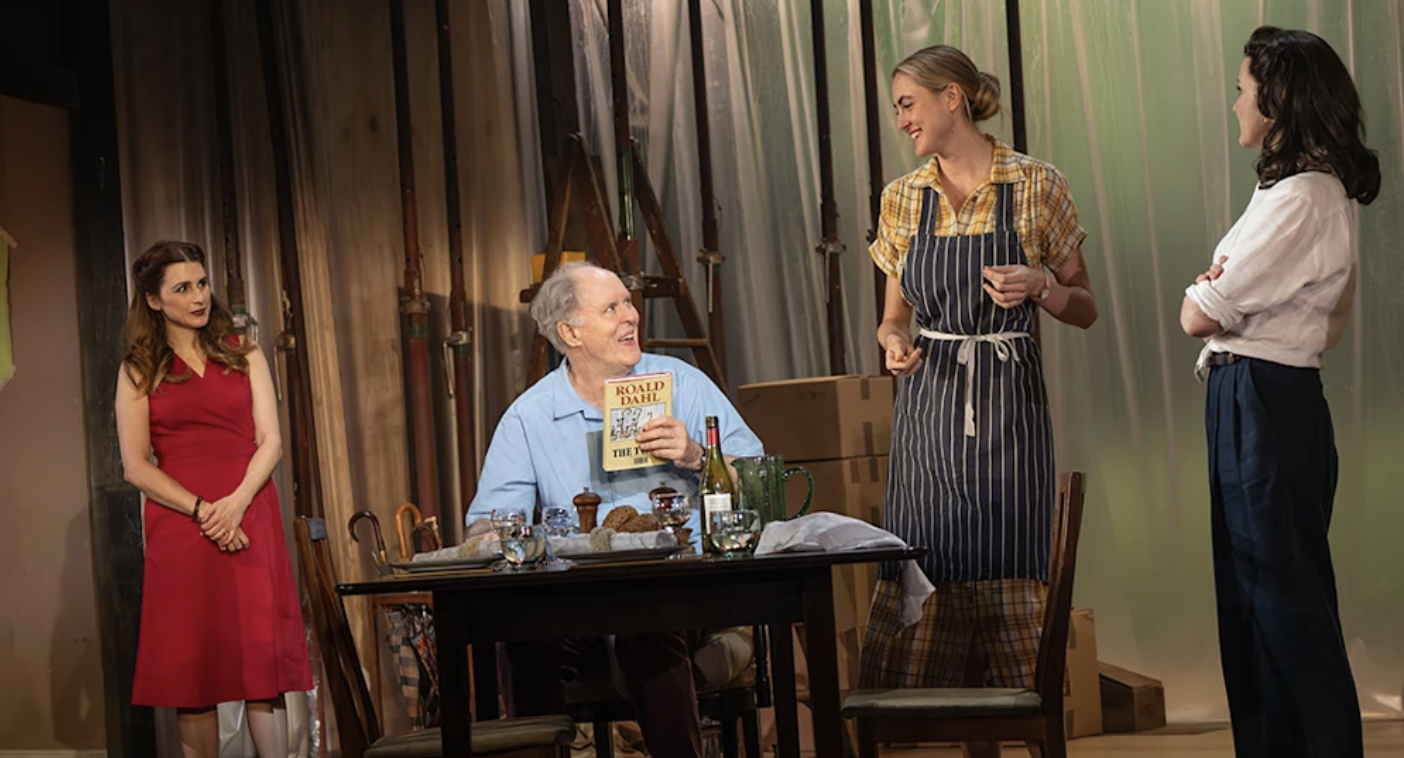
Aya Cash, John Lithgow, Stella Everett, Rachael Stirling (Photo: Joan Marcus)
By Fern Siegel (Posted April 13, 2026)
Mark Rosenblatt’s “Giant” stars John Lithgow as the famous children’s author Roald Dahl. No one does smug and supercilious better than Lithgow, who snarls his way through much of the play.
The focus, however isn’t Dahl’s beloved books, but his blatant anti-Semitism, which he is at pains to showcase.
Broadway’s Giant, now at the Music Box, is based on the author’s real-life scandal. It erupted first in his review of a pro-Palestinian book in 1983, which addressed Israel’s attack in Lebanon, following an assassination attempt on its UK ambassador by a rival Palestinian group and ongoing border shelling from the PLO and the emerging Hezbollah.
The review alarms his agent and his New York publisher’s sales director — and both suggest he offer a public apology. Not only does he refuse, but he’s keen to bait Jessie (Aya Cash) and Tom (Elliot Levey), both of whom are Jewish. When Jessie points out the history of the region, Israeli casualties, and that the U.N. voted to establish the state in the wake of the Holocaust, Dahl is unmoved. She is sensitive to suffering on all sides; his criticism is a one-way street.
As Dahl morphs from charming host to monster, audiences wonder what’s at stake. His book sales may suffer in the U.S., but he doesn’t care. The plot ends there. So where is the drama?
Set in the author’s Oxford home, Lithgow’s Dahl rants and assails his guests incessantly. The rest of the cast either stares at walls or waits for him to finish. They rarely, outside of the likable Jessie, ever confront him. Are literary giants excluded from morality? And/or is Rosenblatt raising the provocative issue of the art vs. the artist?
Either way, the silence or tacit agreements Dahl expects from those around him, including his former mistress/fiancee Liccy (Rachael Stirling), are unbearable. In the Nicholas Hytner-directed show, Jessie, Tom and Liccy have little to do, which makes the pacing rather sluggish and the dialogue heavy-handed. Because Dahl is risking nothing, it’s as much a profile in grandstanding bigotry as a commentary on the dangerous latitude we accord anyone holding status — literary or political.
(In his 1983 novel The Witches, Dahl posits a group of hook-nosed women who print money and kidnap and murder innocent children, playing into ancient anti-Semitic blood libels. The original 1964 edition of Charlie and the Chocolate Factory portrayed the Oompa-Loompas as African pygmies, which was criticized as a racist caricature, but didn’t affect sales.)
While Lithgow fans will enjoy seeing him on stage, it’s Cash who flexes her nuanced acting chops. Giant ends with a phone call with a London reporter quoted verbatim. Dahl’s comments about Hitler are a potent reminder that his legacy, despite his enduring literary popularity, is marred.

Lauren Patten, Alden Ehrenreich (Photo: Marc J. Franklin)
A lighter effort, the dark comedy Becky Shaw, is being revived on Broadway at Second Stage’s Hayes Theater.
Written by Gina Gionfriddo in 2008, the show is funny, pointed and delightfully un-PC — which makes the truth barbs all the more enjoyable. It’s billed as a blind date gone wrong, but it’s so much more.
It opens with the death of Suzanna’s (Lauren Patten) father. She’s sharing her grief with adopted brother Max (Alden Ehrenreich), a money manager who can’t cope with her emotions.
Susan, Suzanna’s mother (Linda Emond), is even more critical: “You didn’t lose a child or even a breast. Your father died of natural causes after a life well-lived. That’s not loss. It’s transition.” Delivered in no-nonsense tone of semi-caustic wit only adds to the laughs. Susan has been left in a financial mess, but it’s Max, devoted to both, who will offer key support.
That support gets blurry with Suzanna. They grew up together, but it’s clear their closeness, despite the endless sniping, is deep. Max also resents her husband Andrew (Patrick Ball), a well-intentioned Brown grad turned barista, who sets Max up with Becky Shaw (Madeline Brewer), a temp in his office.
And that’s when the sparks begin to fly.
Becky Shaw appears helpless and vulnerable, but with a back story that suggests she may be more manipulative than appearances suggest. As the couples pair off and spar, Max explains his difficulty with the set-up: “Romantic relationships are the pairing of equals! That woman is not my equal.” Becky, who didn’t get the message, leans on Andrew for comfort, to Suzanna’s annoyance.
And as the pairs wrestle with issues of morality, marital obligations and emotional dependency, director Trip Cullman keeps the action moving. His ensemble clicks. Edmond is a particular standout, as is Ehrenreich. Both deliver zingers that cut through societal pretension and cultural expectation. And it’s refreshing.
While the set design by David Zinn is rather bare until the final scene, Gionfriddo’s stark comedy comes fast and furious. She makes clear that dating, intimacy and family dysfunction aren’t easy realities, but worth the work.