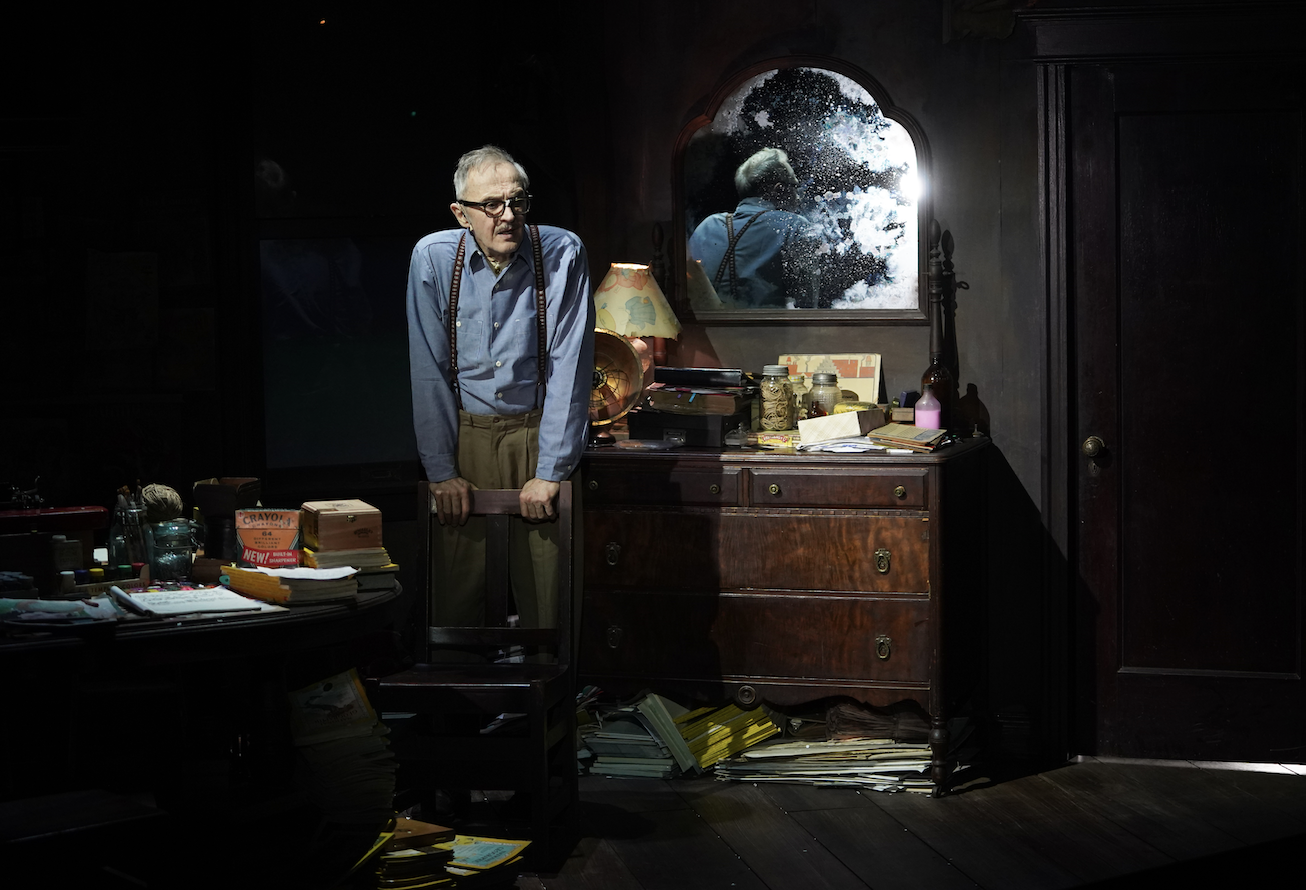
John Kelly (Photo: Carol Rosegg)
By Fern Siegel (Posted March 12, 2026)
The correlation between mental illness and art is an intriguing one. That’s especially true when the topic is Outsider Art, work created by a self-taught artist far removed from the mainstream.
Henry Darger, the focus of Bughouse, may be the most famous Outsider artist in the world, with his paintings now commanding huge sums. It’s a remarkable postscript to a man who suffered loneliness and torment for most of his life.
The off-Broadway play at the Vineyard, based on Darger’s writings, with a script by Beth Henley, directed by Martha Clarke and starring John Kelly, is strangely hypnotic. That’s thanks to Kelly’s moving and vulnerable performance, coupled with masterful production and projection designs. It’s also somewhat incoherent.
Bughouse depicts Darger’s internal story with empathy, but without any dramatic intent. Reading the placards in the theater lobby is crucial. Without it, the play won’t deliver what it needs most: context. And Darger is worthy of note.
In 1972, the retired janitor left his rented rooms in Chicago and moved to a nursing home. In cleaning up, Darger’s landlord made an extraordinary discovery: a 5,000-page autobiography, a 15,000-page novel and several hundred drawings, paintings and collages. The art wasn’t produced for exhibition — Darger created a world to escape his own. And his landlord, himself an artist, realized he was witnessing something exceptional
The isolated recluse, a devout Catholic, was the victim of childhood neglect and institutional abuse, misdiagnosed and warehoused in 1904, at 12, in an asylum for “feeble-minded children.” Darger, obsessed with cruelty toward children, lived for his magnus opus: “The Story of the Vivian Girls, in What is Known as the Realms of the Unreal, of the Glandeco-Angelinian War Storm, Caused by the Child Slave Rebellion.”
He wrote the novel over several decades, usually called “The Realms of the Unreal,” about a fantasy universe where the heroic Christian Vivian Girls, often posited as lambs of God, fight evil adults to free the tortured child slaves. (The leader of the Glandelinians was named after his childhood bully.) He traced newspaper comics and photos, created collages and added his own watercolors to illustrate his saints-vs.-sinners saga. The cache has secured his legacy.
But Bughouse, which needs greater structure and a through line, presumes you know Darger and his art. Are the images flashed on stage his hallucinations or his paintings? He was known as a capable mimic and neighbors often heard voices in his apartment — all belonging to him.
Yet despite its structural flaws, the production is beautifully executed — it’s ambitious to take a man’s internal struggles and transform them into an external universe. We can sympathize with Darger’s suffering, though a partial linear narrative is essential to understand what drove him. It may be that Henley’s script reflects, in part, Darger’s own ramblings. But a gallery-type show as part of the flashed images would better explain Darger’s “Realms” and add context to the fetishism of innocence that dominated his art brut (raw art).
Neil Patel’s production design, John Narun’s amazing projections, Christopher Akerlind’s lighting and Ruth Lingford’s animation are all compelling. The physical reality of Darger’s world is on display. We need a stronger connection between internal struggle and external staging to tie it all together. Bughouse is very watchable. If only it were more decipherable.