Jewish Worlds Illuminated: A Treasury of Hebrew Manuscripts

A miniature manuscript of daily prayers (Vienna, 1724), depicting a woman in her bedroom.
By Dory Adler (Posted Oct. 1, 2025)
Jews have long been known as "People of the Book," due to the importance they place on the Torah and Talmud. But in addition to sacred texts, Jews in the Diaspora explored the diversity of their culture in literary manuscripts.
More than 100 of these have been curated by three scholars from the Jewish Theological Seminary. The exhibition — Jewish Worlds Illuminated: A Treasury of Hebrew Manuscripts — is on view through December 27 at the Grolier Club in Manhattan. The JTS treasure trove explores the land where Jews lived, from Iberia (Spain and Portugal) to the Mideast, North Africa to the Ottoman Empire. The show covers 800 years of Jewish history.
Professor David Kraemer, one of the curators, explains: “In these communities, Jewish wisdom and creativity often found their fullest expression in the creation of books. Manuscripts became vessels of memory, imagination and identity, preserving the richness of Jewish life from antiquity into modern times.”
Some of the gems of the collection include the Prato Haggadah (ca. 1300), an unfinished illuminated manuscript containing the text and order for the Passover Seder.
During the Renaissance, affluent Italian Jews commissioned ornate manuscripts reflective of their status. On view is the Rothschild Mahzor (Florence, 1490), a book of prayers that is one of the most lavishly decorated Hebrew manuscripts produced in Italy in the 15th century.
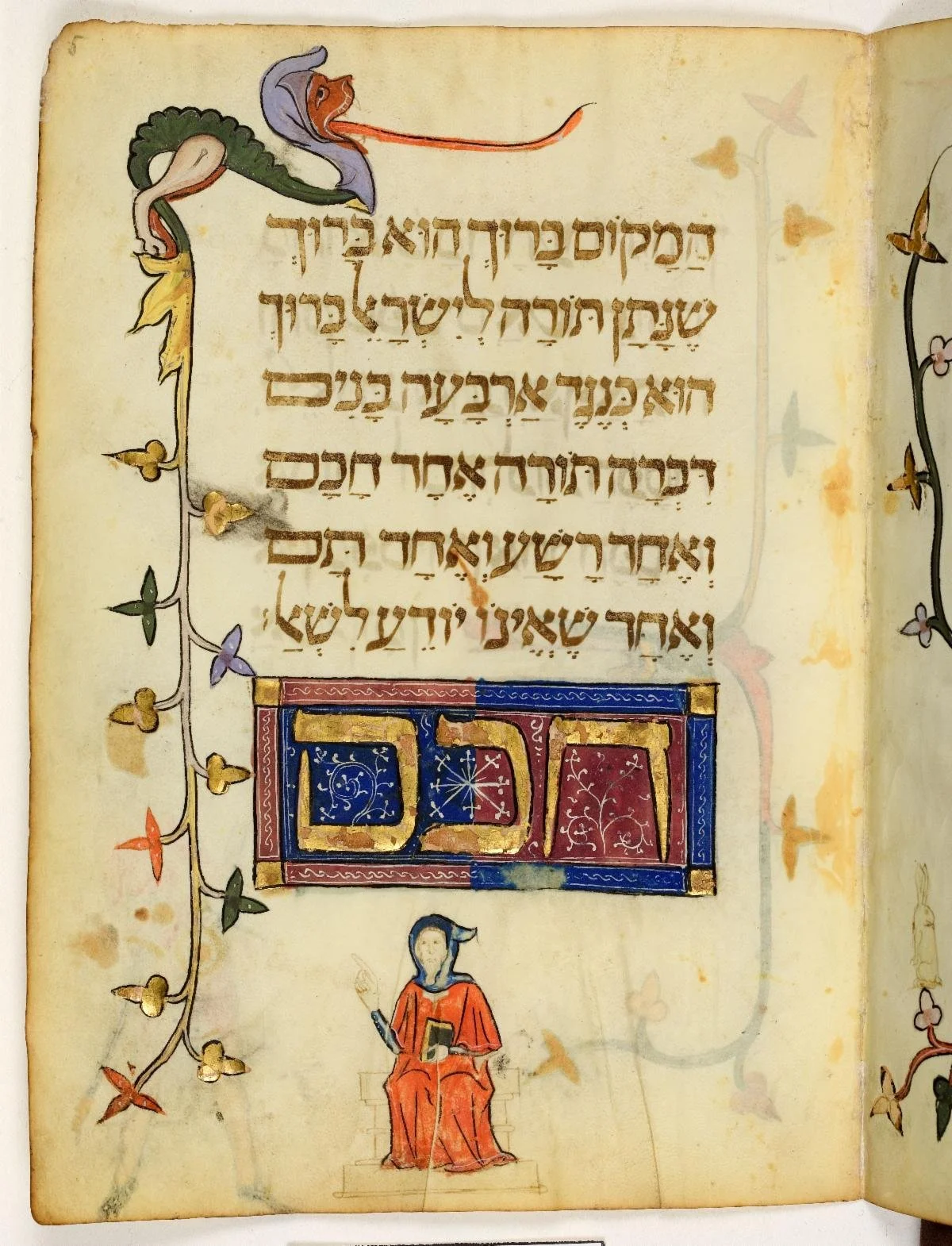
Sephardic artistry from Iberia. Prato Haggadah (ca. 1300)
What’s fascinating is the range of scholarship — it spans the Bible, liturgy, kabbalah, science, literature and philosophy. It also underscores the creative influences.
Jewish communities in Babylonia and Persia (modern-day Iraq and Iran) engaged with the artistic styles of the Islamic culture. And by the 18th century, a revival of Hebrew manuscripts emerged in the German-speaking Hapsburg Empire, which combined traditional Jewish texts with contemporary European artistic styles.
The variety of the work is singular, from floral designs and gold leaf to geometric shapes. Unlike mass-printed books, each manuscript is unique. For historians, it illustrates an important point: Jewish communities maintained their identity, while acculturating into the countries where they lived. That blend produced beautiful books and explains why it’s organized geographically.
“We learned from the local culture, we became part of the local culture, and we contributed to the local culture,” adds Kraemer.
Jewish Worlds Illuminated” runs until Dec. 27, at the Grolier Club, 47 East 60 St., New York. Admission is free.